Friday, April 27, 2012

Advertising and Marketing Within Movies


Wayne's World 1992
Movies for the past 100 years have attributed to the rise of advertising and marketing, because they themselves have been subtly and not so subtly become billboards for major companies such as Coca-Cola, Pepsi, Gatorade, and many others. If you go to a movie theater and watch any movie, before the movies starts you'll get plenty of advertisements. Aside from pre-movie ads, you'll be sure to get some during the movie as well whether it's subtle or blatant. Usually they advertisements are referred to as product placement simply because that's usually all the company puts into a film.

Product placement in movies is a clever way to gain interest in a product, such as Mike Myers from Wayne's World holding a Pizza Hut box with a big smile on his face. What companies hope for is that a high-profile star may draw more attention to their product. While just placing a product anywhere to be seen, it may help to some degree, but when you have a popular star holding or using a particular product, it may help persuade the viewer that particular product is worth getting simply because someone famous is using it.

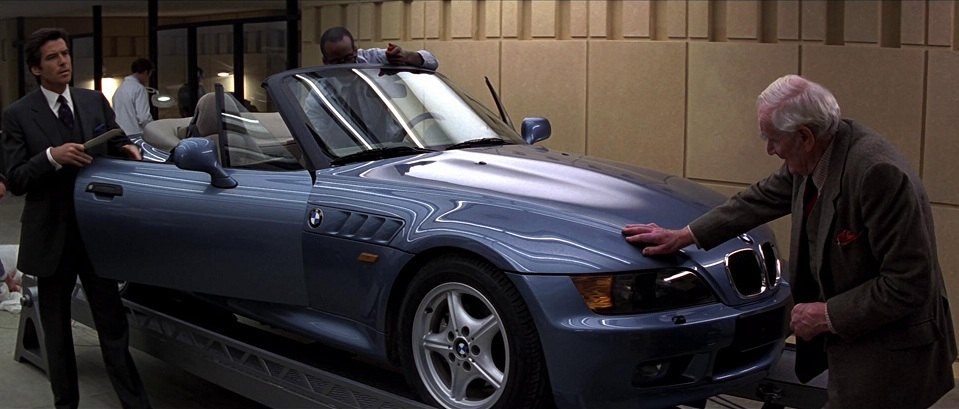
GoldenEye 1995
Even back when movies were still in the silent era, they managed to get product placement into the film. Wings, a 1927 silent film and World War I fighter pilots plugged Hershey's chocolate during the middle of the movie. The 1995 film GoldenEye (James bond film) was the focus of a BMW campaign for their new Z3 model and ended up with skyrocketing sales after the film debuted.

Happy Gilmore 1996
In other films such as Happy Gilmore, there's a section of the movie entirely base on Subway placement and advertising a new sandwich. It's done so cleverly that you don't particularly notice it as an outside advertisement to the viewers but rather it's meant for the people in the movie. Other than Subway, Happy Gilmore contained many more product placements that are considered cheap or poorly done because they're so obvious. They include AT&T, Budweiser, ESPN, and several other companies.
By: Justin Young 

Monday, March 26, 2012

Gaming and Marketing... How does that work?


So how does it work? Many people often do not sit and think about how video games can also be used and intertwined with marketing campaigns. There are thousands of people at any given time playing a video game, which makes it a GREAT place to advertise! This type of advertising is referred to as In-Game advertising. and according to http://en.wikipedia.org/wiki/In-game_advertising In-Game advertising has been done since 1978! Gaming is now also becoming popular on mobile phones. Just about every gaming application you play has some type of advertisement pop up. The point is gaming is not only about kids and the average age of an online gamer is around 35 years old. Playing video games happens very often in my household and it is not just my son or fiance playing the games, it is me also. It is something that can appeal to any consumer which is a very big reason In-Game advertising is becoming so increasingly popular. It is expected that spending on In-Game advertising will grow to 1 billion dollars by 2014. Companies can either place their sine on a billboard or also use something called Static In-Game advertising which basically means once it is in there it cannot easily be changed. For example a piece of the game like a phone or computer system or that is brand specific in the game would be advertising to the brand and could not be changed out of the game. This is a very smart way to do advertising because no matter what happens your product will always be in the game and never changed. When using In-Game billboards as a way to advertise you have to think about screen time and angle within the game that the viewer will be allowed to see. This can change the effectiveness of the advertisement. It seems as though marketers find that companies have an increase in sales by using In-Game advertising however if you ask the daily gamer most of them find the advertisements to be invasive and will even pay to have the advertisements removed if possible. All in all a lot of research has to take place when thinking about using video games as a source of advertisement.
https://twitter.com/#!/Holli_McRae

Saturday, March 24, 2012

Livecasting...Creating a Smaller World :)


As Social Media platforms enable people across the world to connect and communicate in new and innovative ways, and sharing in the process can be exciting and rewarding. By definition livecasting refers to any kind of audio or visual sharing that is done over the internet. Given the
popularity of putting video or audio out into the Internet (and the lure of
having a video go viral) there are many kinds of multimedia livecasting sites
available, You Tube and Skype are just a couple.

YouTube (http://www.youtube.com/) is of course the leader in livecasting sites featuring pre-recorded videos in a variety of categories and genres. YouTube has become so successful it is now
viewed in new media marketing as a crucial component in any social media mix. From starving artists, proud parents, creative minds and Fortune 500 Companies are all using You Tube to get their faces and products in front of as many people as possible with little or no cost.

Skype (http://www.skype.com/) probably the number one recognized platform for multimedia livecasting which enables users to have a life voice conversation utilizing voice over IP
technology (VOIP) or projecting live video and audio streams in real time. Skype moves beyond the conventional phone and allows real time video feed along with the audio feed to give users face-to-face conversations with friends, family and others around the world…and it is FREE for use between Skype account holders. The only requirements are an internet connection, a webcam, and an account with Skype.


Clara meets her Great-Grandparents for the first time....

The world is a smaller place because of this kind of technology being available to the general public. From meeting friends and family, to business communication the opportunities to go beyond the written word promotes better communication and understanding wherever and whenever it is used. The down side to this form of Social Media only comes from the evil in the world and the potential to spread that message also.
Karen Bellman

Wednesday, February 15, 2012

The Importance of Branding, More than a Logo

The Importance of Branding, More than a Logo

A brand establishes an identity for a product, service, or business. It creates a
visual, emotional, and cultural connection between customers and the company, consciously and subconsciously. The ultimate goal of companies is to create the brand the shopper chooses without hesitation or consideration for others, so the brand is more than just the logo image. The brand is the total package: a quality product, from a dependable company, that consumer can trust to be consistent and grow with the ever-changing needs
To attract customers who fit their customer profile, a business image should align with the customers' needs and expectations. Every business needs a brand identity, whether they choose to develop themselves as a brand can be a deciding factor in their success or failure.

Asking some basic questions will help direct the company to creating an identity.

What service or product do you provide? And is there expansion plans or not?
Who is your customer? What do they expect from your product/services?
Who is your competition? And what are they doing right? Where do you differ?

Once the strategy is in place the visual elements can be designed, namely, the logo. A logo makes
a company distinctive, or unique, compared to others in the market. Consumers need a visual way to identify with a company or product and the logo is that visual element. By emphasizing a competitive advantage as part of a logo, companies can position their products or services to stand out in the market and attract more customers.

This all seems basic, and maybe even simple with the right team in place, but the hardest part
is still ahead. Brand promise will keep a company on top, or topple a company quickly. When a company consistently fulfills the expectations of the consumer, their brand promise strengthens the brand and drives further business. Likewise, failure to deliver as promised will result in a breach of trust and diminish the brand. Re-gaining the trust of a disappointed customer is often impossible, so avoiding it from the onset is critical.
The final element in the creation of a brand is the tagline. What word or phrase sums up the product? The tagline is the word/phrase a consumer can spout off the top of their head when they see a logo and it is often used alongside a logo. The tagline associates the logo with the product and is a constant reaffirmation of the brand promise.
"Your Logo is not your Brand"is summarized nicely in a video presentation from Good Morning Marketers, when they interview employees from ThunderTech. Visit the following link to view this presentation. http://www.youtube.com/watch?v=63kxVZBLHnE&feature=related
Karen Bellman
February 15, 2012